[1] "pcoptimizedsettings". pcoptimizedsettings.com. Retrieved March 02, 2025
[2] "Steam Community". steamcommunity.com. Retrieved March 02, 2025
FAQs
If you’ve put everything to Low and still struggle, there are a few extra steps:
Update your drivers – new GPU drivers often include CS2 optimizations.
Close background apps – even a browser or recording software can steal CPU/GPU resources. Also disable Windows Game DVR/clipping if you don’t use it.
Enable XMP/EXPO for RAM – if you have a decent motherboard, make sure your RAM is running at full speed.
Use Performance mode power settings – on Windows, set Power Plan to High Performance and for laptops ensure you’re plugged in (and disable any battery saver.
Lower resolution further or use FSR – try dropping to 1024×768 or even 800×600 (the game will look pixelated but run faster). Or use FSR on a lower quality (Balanced or Performance) – this will noticeably blur the image but can greatly improve FPS by rendering at a much lower res and upscaling.
Check for thermal throttling – if you’re on a laptop/PC that’s overheating, your CPU/GPU might be slowing down. Ensure proper cooling (clean fans, use a cooling pad, etc.).
As a last resort, if nothing helps, consider hardware upgrades. CS2 isn’t extremely demanding, so even an older GPU like a GTX 1050 Ti or RX 570 can run it decently – if you’re below that tier (or using integrated graphics), a cheap used graphics card or more RAM (8 to 16GB) could give you a big boost [2].
Competitively, the consensus is to favor performance and clarity over graphics fidelity. Using Ultra settings might make the game look slightly nicer (you’ll notice it in things like skin details, fancy shadows, volumetric lighting), but those rarely help you win rounds. Higher resolution (1440p, 4K) can actually hurt competitive play if it lowers your FPS below your monitor refresh or introduces input lag. However, if you have a very strong PC that can handle, say, 1440p at 240Hz, some players might enjoy the extra sharpness.
The benefit would be that a distant head at 1440p has more pixels representing it than at 1080p, potentially making long-range aiming easier. But most competitive players value the muscle memory and consistency – and most have trained on 1080p or lower. For pure tryhard competitive mode, stick to what gives you the highest stable FPS (which is usually not Ultra).
If you’re playing more casually (say non-tournament matches, or just with friends), feel free to up some settings or res for visual pleasure since your skill won’t suddenly vanish if you drop from 300 to 200 FPS – it’ll still be smooth. It really comes down to your priorities in the moment.
In CS2, if you’re getting wildly fluctuating FPS or your GPU is running super hot pumping out 500 fps unnecessarily, you might consider using fps_max X to cap it at a stable value (like fps_max 300 or 400). Many players cap at their monitor’s refresh (e.g. 144 or 240) to reduce GPU load and input latency variability.
Running uncapped can sometimes cause additional input lag once you go way above your monitor’s rate (because of how the frames queue). So, if your system is high-end, capping at a reasonable number slightly above your average is a good practice (e.g. you get ~330 fps average, cap at 30.
Definitely cap if you see that your GPU usage is maxed out 100% just to produce extra frames that you don’t need – capping will give your GPU breathing room, lower temps, and can eliminate micro-stutters from fluctuating frame times. Do not use V-Sync for capping – use the console or in-game setting to limit FPS, or use adaptive sync tech like G-Sync/FreeSync which is even better.
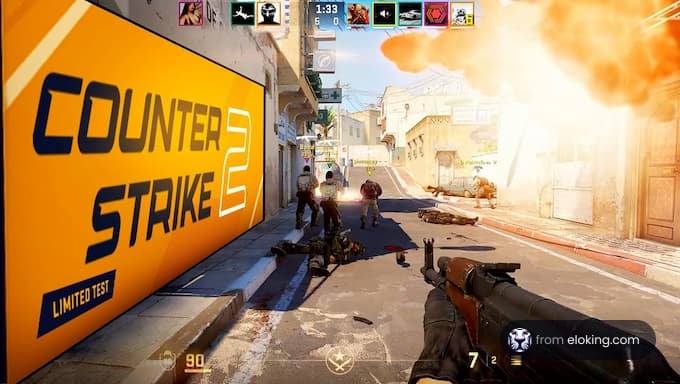
Yes, CS2 is generally more demanding. It’s on the new Source 2 engine with improved graphics (better lighting, realistic smoke, higher poly models, etc.), so it will run at fewer FPS than CS:GO did on the same hardware. Don’t be alarmed – even high-end PCs see lower numbers in CS2 compared to the older game. However, CS2 is still optimized to run on a wide range of PCs. Valve’s philosophy has been to keep CS accessible. They raised the requirements a bit, but as we saw, even low-tier GPUs can handle it with settings tweaks.















 クオリティ
クオリティ
